Beyond Inhibition: What Are PROTACs?
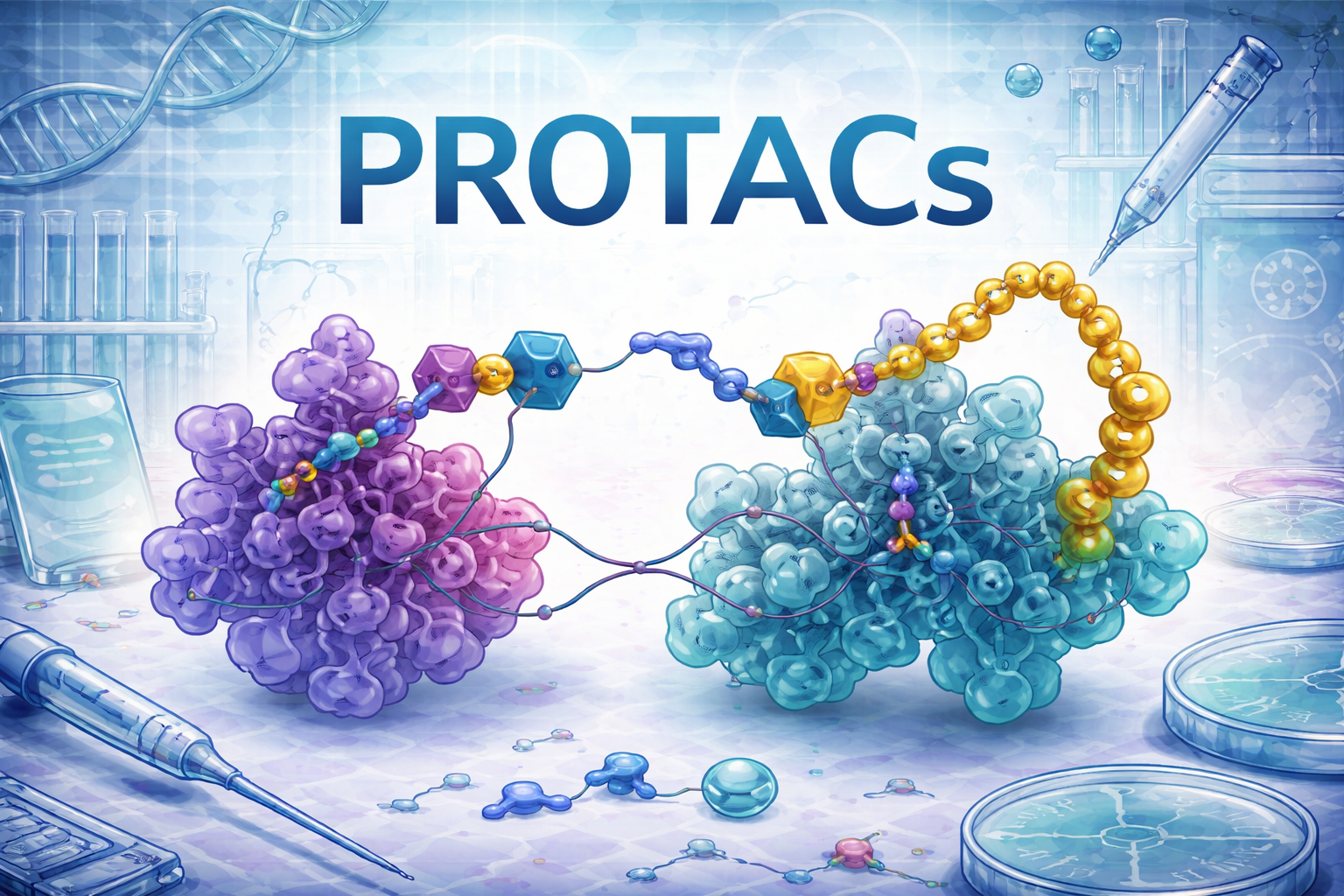
PROTACs (Proteolysis-Targeting Chimeras) are a revolutionary class of heterobifunctional small molecules designed to selectively eliminate disease-causing proteins by hijacking the body’s natural waste disposal system. Unlike traditional inhibitors that only temporarily block a protein's active site, PROTACs act as 'molecular bridges' that bring a Target Protein of Interest (POI) into close proximity with an E3 ubiquitin ligase. This interaction triggers the labeling of the harmful protein with ubiquitin, marking it for irreversible destruction by the proteasome, the cell's internal 'shredder'. Because they operate through a catalytic, event-driven mechanism, a single PROTAC molecule can degrade multiple targets, offering the potential to tackle 'undruggable' proteins that have long escaped conventional drug discovery.
How PROTACs Work: The Catalytic Cycle
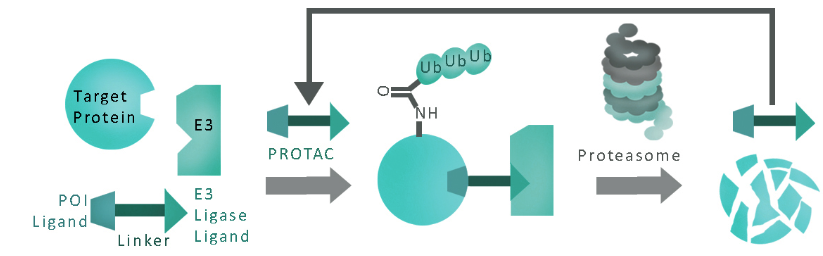
The functional power of a PROTAC lies in its unique "sandwich" structure, consisting of two ligands connected by a chemical linker. One ligand binds to the target protein, while the other recruits an E3 ubiquitin ligase. This formation creates a stable ternary complex, bringing the two proteins into an artificial proximity. Once the complex is formed, the E3 ligase transfers ubiquitin molecules onto the target protein, effectively "tagging" it for disposal. After the tagging is complete, the PROTAC molecule dissociates and moves on to the next target, acting as a catalyst. This event-driven mechanism allows for high potency at lower doses compared to occupancy-driven inhibitors, as a single PROTAC can trigger the degradation of numerous harmful proteins in a continuous cycle.
Revolutionizing the Therapeutic Landscape
PROTAC technology is set to redefine the future of medicine by overcoming the limitations of traditional pharmacology. Its greatest promise lies in its ability to target the "undruggable proteome"—the estimated 80% of proteins that lack deep binding pockets and cannot be blocked by standard inhibitors. By focusing on degradation rather than inhibition, PROTACs can address protein overexpression and mutation-driven resistance more effectively, particularly in oncology, neurology, and autoimmune diseases. As this platform matures, it is expected to be seen a shift toward more durable patient responses and reduced side effects, opening the door to precision therapies that were once thought to be scientifically out of reach.


Elements of PROTAC
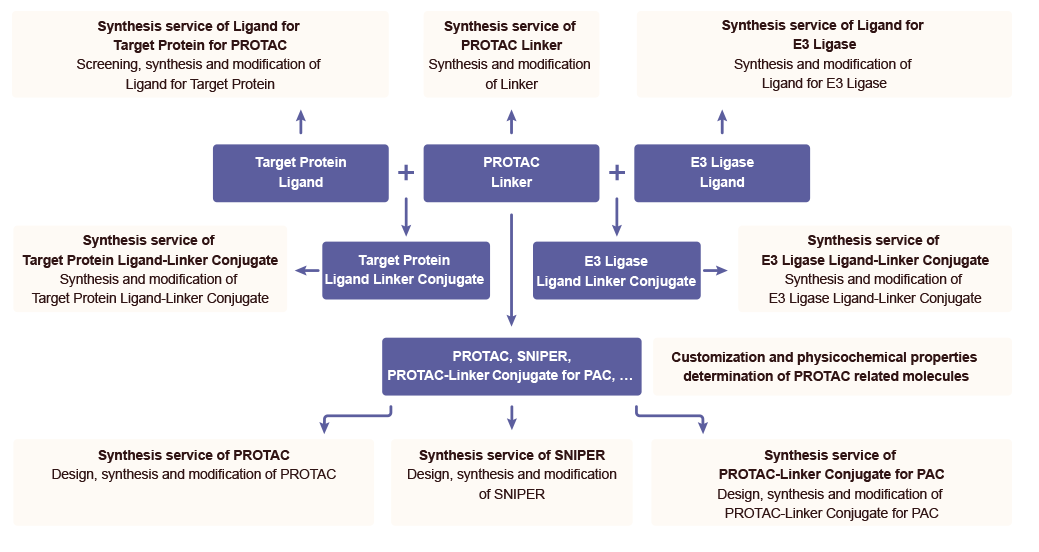
PROTAC molecules are generally composed of three parts: ligand for target protein, linker and ligand for E3 ligase.
E3 ligase is a key structure for target protein ubiquitination. Its ligands include many types, among which CRBN (Cereblon), VHL (von Hippel-Lindau), IAP and MDM2 are now frequently used. Ligands of CRBN with good drug-likeness are generally preferred, followed by VHL and IAP derived from endogenous ligand peptides. Consideration should also be given to the abundance of the corresponding E3 ligase in the cell where the specific target protein is located and the physical and chemical parameters of the final PROTAC.
Linkers are molecules that connect ligand for E3 ligase and ligand for target protein. The properties of linkers have a great influence on the membrane permeability, efficacy and metabolic distribution of PROTAC. The ideal linker length should be able to maintain the lowest binding entropy of the two proteins without affecting their binding in space. There are also studies on multiple connectors and photoswitchable linkers.
As the guiding group of PROTAC, target protein ligand is responsible for capturing the target protein, which requires high coordination ability and selectivity. In practical applications, existing inhibitors and activators of proteins can be used as ligand candidates, while proteins without related molecule reports can be searched for ligands by high-throughput screening and Virtual Screening. It is not necessary for ligands to be inhibitor or agonist, but it should be highly specific to the target protein.
| E3 Ligase Ligand-Linker Conjugate |  |
SNIPER |  |
| PROTAC-Linker Conjugate for PAC |  |
Target Protein Ligand-Linker Conjugate |  |
MedChem Express Services
MedChemExpress (MCE) can provide one-stop services for the design, synthesis, analysis, purification, optimization, detection and evaluation of PROTAC-related products (Ligand for E3 Ligase、PROTAC Linker、Ligand for Target Protein for PROTAC、E3 Ligase Ligand-Linker Conjugate、Target Protein Ligand-Linker Conjugate、PROTAC、SNIPER、PROTAC-Linker Conjugate for PAC).
Related Compound Screening Libraries
| Molecular Glue Compound Library | PROTAC Library |
| E3 Ligase Ligand Library | Target Protein Ligand Library |

PROTACs & Protein Degradation Services
Advantages
- Promotes degradation that circumvents the native resistance of proteins against sustained inhibition
- Select weak binding and promiscuous ligands can be utilized with PROTACs and still demonstrate high degradation efficacy
- Ineffectual ligands which do not modulate the cellular functions of the protein of interest can be used to mediate degradation through PROTACs
- PROTACs could have the ability to degrade proteins previously believed to be 'undruggable' through conventional small molecule inhibition
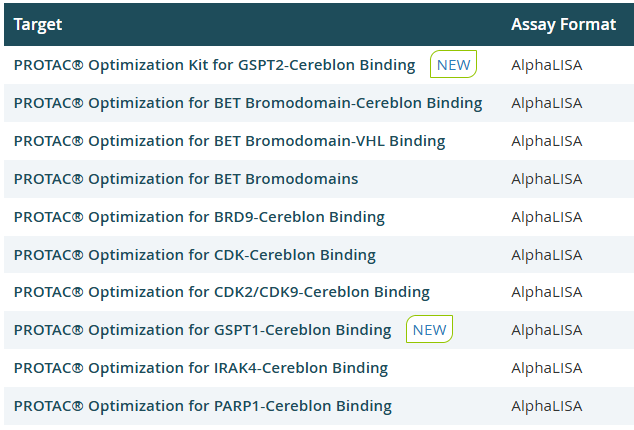
Available Service Assay
Custom Development
In addition to the existing portfolio, BPS Bioscience has the capabilities to develop custom PROTAC and Protein Degradation assays specialized for your project details.
Example assay
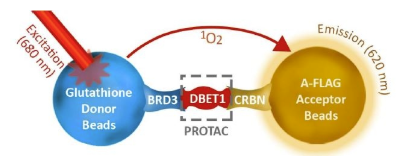
The PROTAC Optimization Assay for BET Bromodomain-Cereblon Binding is designed for testing and profiling of PROTACs directed against BET Bromodomain family and Cereblon complex. Cereblon (CRBN) is a Substrate recognition component of a DCX (DDB1-CUL44-Rbx1 ) E3 protein ligase complex that mediates the ubiquitination and subsequent proteasomal degradation of target proteins.
With this assay, only three simple steps on a microtiter plate are required for PROTAC activity detection. First, a sample containing PROTAC is incubated with CRBN and BRD3(BD2), one of BET bromodomains. Next, acceptor beads are added, then donor beads, followed by reading the Alpha-counts.
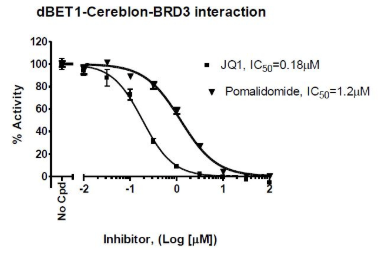
Inhibition by (+)-JQ1 (BPS Bioscience #27401) or Pomalidomide of dBET1-mediated interaction of Cereblon with BRD3(BD2), measured using the PROTAC Optimization Kit for BET Bromodomain Cereblon Binding, BPS Bioscience #79770.
Purchase all these products through DBA Italia

Alcuni dei nostri brand